Saturday, 21 December 2019

IMO regulations 2020

IMO Marine Engine Regulations

Background

International Maritime Organization (IMO) is an agency of the United Nations which has been formed to promote maritime safety. It was formally established by an international conference in Geneva in 1948, and became active in 1958 when the IMO Convention entered into force (the original name was the Inter-Governmental Maritime Consultative Organization, or IMCO, but the name was changed in 1982 to IMO). IMO currently groups 167 Member States and 3 Associate Members.
IMO ship pollution rules are contained in the “International Convention on the Prevention of Pollution from Ships”, known as MARPOL 73/78. On 27 September 1997, the MARPOL Convention has been amended by the “1997 Protocol”, which includes Annex VI titled “Regulations for the Prevention of Air Pollution from Ships”. MARPOL Annex VI sets limits on NOx and SOx emissions from ship exhausts, and prohibits deliberate emissions of ozone depleting substances from ships of 400 gross tonnage and above engaged in voyages to ports or offshore terminals under the jurisdiction of states that have ratified Annex VI.
The IMO emission standards are commonly referred to as Tier I...III standards. The Tier I standards were defined in the 1997 version of Annex VI, while the Tier II/III standards were introduced by Annex VI amendments adopted in 2008, as follows:
  • 1997 Protocol (Tier I)—The “1997 Protocol” to MARPOL, which includes Annex VI, becomes effective 12 months after being accepted by 15 States with not less than 50% of world merchant shipping tonnage. On 18 May 2004, Samoa deposited its ratification as the 15th State (joining Bahamas, Bangladesh, Barbados, Denmark, Germany, Greece, Liberia, Marshal Islands, Norway, Panama, Singapore, Spain, Sweden, and Vanuatu). At that date, Annex VI was ratified by States with 54.57% of world merchant shipping tonnage.
    Accordingly, Annex VI entered into force on 19 May 2005. It applies retroactively to new engines greater than 130 kW installed on vessels constructed on or after January 1, 2000, or which undergo a major conversion after that date. The regulation also applies to fixed and floating rigs and to drilling platforms (except for emissions associated directly with exploration and/or handling of sea-bed minerals). In anticipation of the Annex VI ratification, most marine engine manufacturers have been building engines compliant with the above standards since 2000.
  • 2008 Amendments (Tier II/III)—Annex VI amendments adopted in October 2008 introduced (1) new fuel quality requirements beginning from July 2010, (2) Tier II and III NOx emission standards for new engines, and (3) Tier I NOx requirements for existing pre-2000 engines.
    The revised Annex VI entered into force on 1 July 2010. By October 2008, Annex VI was ratified by 53 countries (including the Unites States), representing 81.88% of tonnage.
Emission Control Areas. Two sets of emission and fuel quality requirements are defined by Annex VI: (1) global requirements, and (2) more stringent requirements applicable to ships in Emission Control Areas (ECA). An Emission Control Area can be designated for SOx and PM, or NOx, or all three types of emissions from ships, subject to a proposal from a Party to Annex VI.
Existing Emission Control Areas include:
  • Baltic Sea (SOx: adopted 1997 / entered into force 2005; NOx: 2016/2021)
  • North Sea (SOx: 2005/2006; NOx: 2016/2021)
  • North American ECA, including most of US and Canadian coast (NOx & SOx: 2010/2012).
  • US Caribbean ECA, including Puerto Rico and the US Virgin Islands (NOx & SOx: 2011/2014).
Greenhouse Gas Emissions. 2011 Amendments to MARPOL Annex VI introduced mandatory measures to reduce emissions of greenhouse gases (GHG). The Amendments added a new Chapter 4 to Annex VI on “Regulations on energy efficiency for ships”.

NOx Emission Standards

The NOx emission limits of Regulation 13 of MARPOL Annex VI apply to each marine diesel engine with a power output of more than 130 kW installed on a ship. A marine diesel engine is defined as any reciprocating internal combustion engine operating on liquid or dual fuel. There are two exceptions: engines used solely for emergencies and engines on a ships operating solely within the waters of the state in which they are flagged. The later exception only applies if these engines are subject to an alternative NOx control measure.
NOx emission limits are set for diesel engines depending on the engine maximum operating speed (n, rpm), as shown in Table 1 and presented graphically in Figure 1. Tier I and Tier II limits are global, while the Tier III standards apply only in NOx Emission Control Areas.
Table 1. MARPOL Annex VI NOx emission limits
TierDateNOx Limit, g/kWh
n < 130130 ≤ n < 2000n ≥ 2000
Tier I200017.045 · n-0.29.8
Tier II201114.444 · n-0.237.7
Tier III2016†3.49 · n-0.21.96
† In NOx Emission Control Areas (Tier II standards apply outside ECAs).
Tier II standards are expected to be met by combustion process optimization. The parameters examined by engine manufacturers include fuel injection timing, pressure, and rate (rate shaping), fuel nozzle flow area, exhaust valve timing, and cylinder compression volume.
Tier III standards are expected to require dedicated NOx emission control technologies such as various forms of water induction into the combustion process (with fuel, scavenging air, or in-cylinder), exhaust gas recirculation, or selective catalytic reduction.
Pre-2000 Engines. Under the 2008 Annex VI amendments, Tier I standards become applicable to existing engines installed on ships built between 1st January 1990 to 31st December 1999, with a displacement ≥ 90 liters per cylinder and rated output ≥ 5000 kW, subject to availability of approved engine upgrade kit.
Testing. Engine emissions are tested on various ISO 8178 cycles (E2, E3 cycles for various types of propulsion engines, D2 for constant speed auxiliary engines, C1 for variable speed and load auxiliary engines).
Addition of not-to-exceed (NTE) testing requirements to the Tier III standards is being debated. NTE limits with a multiplier of 1.5 would be applicable to NOx emissions at any individual load point in the E2/E3 cycle.
Engines are tested using distillate diesel fuels, even though residual fuels are usually used in real life operation.
Further technical details pertaining to NOx emissions, such as emission control methods, are included in the mandatory “NOx Technical Code”, which has been adopted under the cover of “Resolution 2”.

Sulfur Content of Fuel

Annex VI regulations include caps on sulfur content of fuel oil as a measure to control SOx emissions and, indirectly, PM emissions (there are no explicit PM emission limits). Special fuel quality provisions exist for SOx Emission Control Areas (SOx ECA or SECA). The sulfur limits and implementation dates are listed in Table 2 and illustrated in Figure 2.
Table 2. MARPOL Annex VI fuel sulfur limits
DateSulfur Limit in Fuel (% m/m)
SOx ECAGlobal
20001.5%4.5%
2010.071.0%
20123.5%
20150.1%
20200.5%
Heavy fuel oil (HFO) is allowed provided it meets the applicable sulfur limit (i.e., there is no mandate to use distillate fuels).
Alternative measures are also allowed (in the SOx ECAs and globally) to reduce sulfur emissions, such as through the use exhaust gas cleaning systems (EGCS), aka scrubbers. For example, in lieu of using the 0.5% S fuel (2020), ships can fit an exhaust gas cleaning system or use any other technological method to limit SOx emissions to ≤ 6 g/kWh (as SO2).

Greenhouse Gas Emissions

MARPOL Annex VI, Chapter 4 introduces two mandatory mechanisms intended to ensure an energy efficiency standard for ships: (1) the Energy Efficiency Design Index (EEDI), for new ships, and (2) the Ship Energy Efficiency Management Plan (SEEMP) for all ships.
  • The EEDI is a performance-based mechanism that requires a certain minimum energy efficiency in new ships. Ship designers and builders are free to choose the technologies to satisfy the EEDI requirements in a specific ship design.
  • The SEEMP establishes a mechanism for operators to improve the energy efficiency of ships.
The regulations apply to all ships of 400 gross tonnage and above and enter into force from 1 January 2013. Flexibilities exist in the initial period of up to six and a half years after the entry into force, when the IMO may waive the requirement to comply with the EEDI for certain new ships, such as those that are already under construction.
In April 2018, the IMO adopted an Initial Strategy on the reduction of GHG emissions from ships [3949]. The strategy calls for strenghtening the EEDI requirements and a number of other measures to reduce emissions, such as operational efficiency measures, further speed reductions, measures to address CH4 and VOC emissions, alternative low-carbon and zero carbon fuels, as well as market-based measures (MBM).

Other Provisions

Ozone Depleting Substances. Annex VI prohibits deliberate emissions of ozone depleting substances, which include halons and chlorofluorocarbons (CFCs). New installations containing ozone-depleting substances are prohibited on all ships. But new installations containing hydro-chlorofluorocarbons (HCFCs) are permitted until 1 January 2020.
Annex VI also prohibits the incineration on board ships of certain products, such as contaminated packaging materials and polychlorinated biphenyls (PCBs).
Compliance. Compliance with the provisions of Annex VI is determined by periodic inspections and surveys. Upon passing the surveys, the ship is issued an “International Air Pollution Prevention Certificate”, which is valid for up to 5 years. Under the “NOx Technical Code”, the ship operator (not the engine manufacturer) is responsible for in-use compliance.


Thanks
Merchant navy info 

Crank case explosion in marine diesel engine

What is crankcase explosion ?

  • It is an explosion that occurs in the crankcase because of the mixture of oil mist and air in the ratio that is within the range of flammability.
  • In addition there must be a source of high temperature energy sufficient to initiate combustion. This source is called hot spot.

What are the causes of crankcase explosion ?

  • The normal content of crankcase is air.
  • In this air there are oil globules (droplets) formed by the mechanical atomization of the oil as it s sprayed from the edge of the bearing and other places and as it is thrown about and churned by the quickly moving parts.
  • If a hot spot occurs the oil particles in the neighborhood will evaporate.
  • This evaporation may cause the formation of a quantity of white condense oil mist in the cooler regions.
  • The continual generation of heat at hot spot vaporization may proceed a space until the ratio of vapour to air lies within the range of flammability.
  • If hot spot can provide the necessary heat for ignition of vapour, a primary explosion may occur.

What is hot spot and why it occur ?

  • It is an overheated part, sufficient to initiate combustion.
  • A hot spot occur due to the following reasons.
  • Failure of lube oil to bearing, sprockets and similar parts.
  • Hot gas blowing past the pistons may provide spark sufficient to cause an explosion in the trunk type pistons engine.
  • Hot spot temperature: 280 °C  to 400 °C above the L.O flash point

How will you know whether hot spot is there or not ?

  1. By hand feel to crankcase door
  2. Abnormal noise in crankcase.
  3. Irregular running of engine
  4. Bearing L.O temperature increase
  5. Alarm will operate when it reach at oil mist concentration 2.5 – 5% LEL
  6. Smelling & appearance of the dense oil mist when open breather pipe, drain cock.

How to prevent the crankcase explosion ?

  • To minimize the formation of explosive mixture breather pipe or exhaust fan fitted on crankcase.
  • To prevent the formation of hot spot in the crankcase, the bearing should be in correct running clearance, lubricating oil should be adequately supplied to bearing , chain with sprocket wheels and other running parts.
  • The piston with rings and cylinders should be in safe working limits.
  • Good fitting and efficient locking of working parts.
 Preventive measure of crankcase explosion
  1. There should be adequate cooling of the engine.
  2. Proper purification and analysis of lube oil.
  3. Lube oil filter to be changed over & cleaned as per schedule.
  4. Ensure proper cylinder lubrication by checking the condition of piston, piston rings and liner through scavenge ports.
  5. Clean scavenge space as per schedule & drain scavenges space regularly.
  6. Maintain the stuffing box gland sealing in good condition.
  7. All running gears maintenance & checks to be carried out as per PMS.
  8. Be alert & rectify for any abnormal noise in crankcase.
  9. All safety trips & alarms fitted on M/E to be tried out for satisfactory.
  10. Proper watch on all running gears temperature & pressure to be maintained.
  11. Blow through all sampling tubes of Oil Mist Detector (OMD) regularly.
  12. Zero adjustment & sensitivity of OMD to be checked regularly.
  13. Check for oil leakage at crankcase explosion relief doors & check for the operation by hand.
  14. Check flame trap for cleanliness and intact condition.

What will be your action after detecting a hot spot ?

  1. Inform chief engineer & bridge
  2. Reduce the engine speed to reduce the heat generation
  3. Increase lubrication to the running surfaces
  4. Keep clear off crankcase relief door to prevent personnel injury, keep fire extinguisher ready and open skylight.
  5. Inform bridge, stop engine, open indicator cocks, engage turning gear and turn engine with lube oil circulation continuing to prevent engine seizure.
  6. After about 30 minutes when the engine is sufficiently cooled down, stop lube oil pumps and open crankcase door.
  7. Try to locate the hot spot by hand feeling over and by observation like change in colour.
  8. If the hot spot is located, prevent re-occurrence by making permanent repair.
  9. Make thorough inspection of crankcase.
  10. Pay particular attention to hot bearings, piston, bottom end bolts, guides and piston rod around stuffing box.
  11. Start lube oil pumps and check for proper flow of oil from every lubrication point.
  12. If everything is found normal, inform bridge, start the engine and gradually increase speed.
  13. Outside feel over sequence to be carried out for satisfactory operation.

What are crankcase safety devices ?

  1. Breather pipe with flame trap
  2. Crankcase exhaust fan
  3. Oil mist detector
  4. Crankcase relief doors
  5. Bearing temperature sensor
  6. L.O return temperature sensor
  7. Routine test on used L.O for viscosity, flash point and contamination.

Why is breather pipe fitted in the crankcase ?

  • It is fitted to prevent crankcase explosion and to reduce pressure build up in it.
  • It maintains the pressure level in the crankcase about 25mm of water below the atmospheric pressure.

Why crank case relief valve is fitted ?

  • It is fitted to release any sudden rise of internal pressure with large free escape area thus to prevent secondary explosion.

What are the requirements of crankcase relief valves ?

  1. The internal combustion engine of cylinder diameter of 200 mm or a crankcase volume of 0.6 m3 and above shall be provide with crankcase relief valve of a suitable type with sufficient relief area.
  2. In small engine, cylinder diameter not more than 300mm, crankcase door of which are usually very strong. It may have relief valve or valves at its end.
  3. In large engine, cylinder diameter more than 300mm, require one relief valve to be placed on each crankcase door.
  4. Its free area should not be smaller than 45cm2 and there shall be minimum of 115cm2 /m3 of the gross crankcase volume.
  5. Spring setting for opening pressure is 0.07 bar at an internal pressure and will close when the pressure has been relieved.
  6. The valves open smartly and close positively and rapidly.

How would you test crankcase relief valve ?

  • When engine is stopping, after removing the flame trap and press up the valve disc and check the action of opening and closing.
  • The valve must be opened smartly and closed positively and rapidly.
  • The valve must be oil and gas tight.
  • When the engine is running we must only check the oil leakage that shows the v/v is seal or not.

What are the causes of bearing high temperature ?

  1. Improper viscosity of oil
  2. Insufficient lubrication
  3. Misalignment of shaft or bearings
  4. Foreign matters in oil
  5. Score in journal
  6. Poorly fitted bearing
  7. Improper oil clearance
  8. Whenever the bearing begins to heat up, check the lubrication whether it is clear, correct temperature and flow sufficient or not.

What is the blow past / blow by ?

  • Blow past and blow by are the same. Hot gas or flame passed through the piston rings and cylinder liner from the combustion space.

What are the source of oil coming into air bottle ?

  • Excessive oil level of compressor
  • Excessive cylinder lubrication
  • Defective oil scraper rings
  • Oil vapours inhaled from the engine room atmosphere.

What point to be checked during crankcase inspection ?

  • Appearance of all parts inside the crankcase
  • Hot spot
  • Corrosion
  • Wear and tear
  • Locking arrangement
  • Bolts tightness
  • Chain inspection
  • Lube oil system
  • Metal chip in the crankcase
  • Bearing clearances
  • Crankcase relief valves, flame trap
  • Crankcase door joints
  • Crankshaft deflection

Why oil mist detector is fitted ?

  • It is fitted to detect the oil mist concentration in the crankcase and to give early warning.
  • To prevent the primary explosion.
  • Alarm setting is 2.5% of the lower flammable limit.

What are oil mist detector maintenance ?

  • Daily check alarm system.
  • Check for any abnormal alarms in the panel.
  • Detector head cleaning.
  • Make sure fans is working.

How will you take action when oil mist detector alarm is on ?

  • Inform to chief engineer
  • Inform bridge, take the permission to stop the engine
  • Gradually reduce the engine and then stop.
  • Cool down the engine.
  • Check the inside parts of the crankcase inspection.
  • Make necessary repair
  • Reset OMD and start engine

Turbocharger working


A significant difference between a turbocharged diesel engine and a traditional naturally aspirated gasoline engine is the air entering a diesel engine is compressed before the fuel is injected. This is where the turbocharger is critical to the power output and efficiency of the diesel engine.
It is the job of the turbocharger to compress more air flowing into the engine’s cylinder. When air is compressed the oxygen molecules are packed closer together. This increase in air means that more fuel can be added for the same size naturally aspirated engine. This then generates increased mechanical power and overall efficiency improvement of the combustion process. Therefore, the engine size can be reduced for a turbocharged engine leading to better packaging, weight saving benefits and overall improved fuel economy.

How Does a Turbocharger Work?

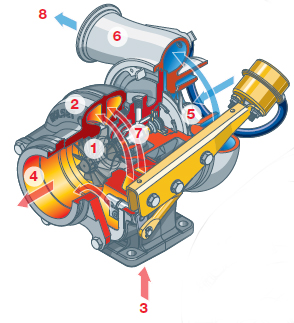
A turbocharger is made up of two main sections: the turbine and the compressor. The turbine consists of the turbine wheel (1) and the turbine housing (2). It is the job of the turbine housing to guide the exhaust gas (3) into the turbine wheel. The energy from the exhaust gas turns the turbine wheel, and the gas then exits the turbine housing through an exhaust outlet area (4).
The compressor also consists of two parts: the compressor wheel (5) and the compressor housing (6). The compressor’s mode of action is opposite that of the turbine. The compressor wheel is attached to the turbine by a forged steel shaft (7), and as the turbine turns the compressor wheel, the high-velocity spinning draws in air and compresses it. The compressor housing then converts the high-velocity, low-pressure air stream into a high-pressure, low-velocity air stream through a process called diffusion. The compressed air (8) is pushed into the engine, allowing the engine to burn more fuel to produce more power.
how-a-turbocharger-works.png

  1. The turbine wheel
  2. The turbine housing
  3. Exhaust gas
  4. Exhaust outlet area
  5. The compressor wheel
  6. The compressor housing
  7. Forged steel shaft
  8. Compressed air

Starting of auxiliary engine

Starting procedure of a generator engine


Starting of an engine from "stop" state is something which needs to be done with care, especially if the interval of starting is sufficiently long. The following is a checklist of all the checks which ideally need to be carried out before starting the generator. In actual practice sometimes the engineers might take some of these for granted and skip, but it is advisable not to indulge in such a practice. Infact these checks are generic for any four stroke engine starting process
  1. Check the turbocharger sump oil level, governor, alternator, forward and aft lube oil levels, and diesel oil level in service tank
  2. Open the indicator cock
  3. Prime the lube oil to all parts by hand pump or by motor driven priming pump
  4. Ensure that all jacket cooler valves, lube oil cooler valves, air cooler valves should be in open position
  5. With use of the Turning bar turn the fly wheel and check for any resistance on the bottom end bearing and check any water / fuel coming out through indicator cocks
  6. While turning engine, check all visible lube oil points are lubricated
  7. Remove the turning bar from fly wheel and put in the place
  8. Drain the auxiliary air bottle
  9. Blow through engine (ie: by turning engine with air). In order to ensure that no water is inside combustion chamber if it is present it may cause water hammering
  10. Close the indicator cocks and pull lever from stop to start
  11. When the needle in RPM indicator deflects to some value of (0-25 rpm) put the lever in run condition
  12. The engine will run on fuel oil once the generator picks up the rated speed
  13. Put generator on load by closing air circuit breaker
  14. For checking the alternator fore and aft bearing lube oil level by opening oil plug in the alternator and the ring bearing while rotating splash lube oil from the sump can be seen
  15. In order to synchronize the incoming generator with running generator syncroscope method/dark lamp method is used

Tug boat engine start up


Rolling pitching concept


Marine boiler operation


Easy and quick way to pass MEO CLASS4


8 things to know before joining merchant navy

Carreer in merchant navy;


Planning to join merchant navy? Merchant navy is a unique career choice, but then there are certain things that you should consider before making it your career. The list of why merchant marine is a very good career option (or not so good one),  is very long but with the help of these top eight points, knowing why to opt for marine careers and what to look out for before joining the merchant navy will become genuinely easy.

1. Right Qualification 

As with most professions, the right qualifications are necessary for this job too. Owing to the specialized nature of the work on board ship, it is mandatory to have the right skillset for this line of work as well. Respective streams for respective work on board require a very focused skill set to be applied practically.Therefore, the right institute is also to be taken into consideration as there are many to choose from. Different countries have their own merchant navy rules and academies so it becomes necessary to enroll in the appropriate Institute as required by the nation’s merchant marine laws to get the required qualifications.


8 Things to Keep in Mind Before Joining Merchant Navy

Planning to join merchant navy? Merchant navy is a unique career choice, but then there are certain things that you should consider before making it your career. The list of why merchant marine is a very good career option (or not so good one),  is very long but with the help of these top eight points, knowing why to opt for marine careers and what to look out for before joining the merchant navy will become genuinely easy.
What is the Difference between Merchant Navy and Defence Navy?
 
10 Reasons Why a Career in Merchant Navy is Unlike Any Other

1. Right Qualification 

As with most professions, the right qualifications are necessary for this job too. Owing to the specialized nature of the work on board ship, it is mandatory to have the right skillset for this line of work as well. Respective streams for respective work on board require a very focused skill set to be applied practically.
Therefore, the right institute is also to be taken into consideration as there are many to choose from. Different countries have their own merchant navy rules and academies so it becomes necessary to enroll in the appropriate Institute as required by the nation’s merchant marine laws to get the required qualifications.
seafarers

2. Choose the Right Job 

As mentioned above, the right stream must be chosen by an individual commensurate with his interest in that specific area of study followed by work. Merchant marine offers a lot of job options – from technical to non-technical professionals. Radio officers, captains, able-bodied seamen, chefs, first mate and second mate are the kind of jobs that are available to the interested people. You are the best judge of your capabilities, so choose your stream accordingly. Some positions come with high responsibilities and you should be ready to deliver your best.

3. Health and Fitness

The sea tests human endurance, both physically and mentally. It is important to be fit physically as well as to have the right mental constitution to be prepared for any situation onboard. You wouldn’t be selected if you are not fit. Since the merchant navy men have to be on the water for a major portion of the year, their health and fitness become a major concern. Fitness is an aspect that not only pertains to an individual but also the others on board ship; seeing as all work on board is teamwork and one job affects another. Therefore, lax performance in one area can put the other areas to risk. Safety being of paramount importance, it is not prudent to have unfit people on board.Do note that health and physical fitness tests are carried out at regular intervals of time. They are conducted every time before boarding the ship and if any complication arises, the candidate will not be allowed to join the ship. Passing the test during the time for admission in the course does not ensure you are fit for sea life. There are some tests which are carried in between the course (hearing compatibility test etc.) which if failed will lead to termination of the course.


4. Almost Negligible Social Life 

The fourth aspect involved is about the amount of time spent offshore. If you are a social animal who likes to mingle with friends on every opportunity you can find, then better stay away from Merchant navy. The life at sea is a lonely one and takes a toll on your social life; some prefer it and some don’t- whoever tells you otherwise is lying outright. With the extent of work and lack of free time to pursue social interests, ship life can get quite hard for a person.
phone talking
Credits: lunamarina/wikipedia.org
Modern ships have internet and satellite phones which virtually reduce the distance from friends and family; however, it is no replacement for the usual social life on shore and more than that, the work leaves little to no room to engage in long conversations over the phone! It is also prudent to remember that this aspect is more than negated by the all the new places that one gets to discover (subject to time available). If the person is adventurous, then the time period could go to the person’s advantage but if the person has a shy personality and needs emotional anchorage from friends and family then marine careers could be disadvantageous as it could lead to homesickness and unnecessary problems due to the person’s inability to adjust to the job.


5. Personality and Attitude 

Seeing the same lot of people over months can automatically harbor resentment within an individual; if not resentment, then plain boredom! Men of strong mental constitution tend to keep it together throughout their contract by having a positive personality with the right attitude towards the work at hand as well the people he’s working with. Being a part of the merchant navy will allow a person to not only meet new people but learn lots of new things about different cultures of the world.
bridge team
Representation Image – Photograph by Jose Jacob
If you feel you are not the kind of person, who can compartmentalize his or her mind, then better give this career a miss. This is why it becomes important before joining merchant navy to know what type of a person one is and whether merchant navy will suit the person or not. Have some time to yourself and then decide.


6. Job surety and high income

Opportunities onshore have increased many times over for merchant navy professionals who are willing to put in the time. While the power/command and the pay on board cannot be met fully on shore while starting out, putting in the years onshore or starting the right business can garner equal or sometimes, even more, income than at sea.  As far as jobs at sea go, with the cyclical nature of the shipping industry, we are in the bust cycle at the moment which has caused a slowdown in jobs and recruitment; there is job crunch in the seafaring industry especially at the entry level (junior officers).Candidates who cleared the required courses are finding it difficult to get a ship for completing their sea-time and training so that they can appear for competency exam to become officers. A qualified seafarer past his training phase on board gets paid rather well but the initial stages are hard (for deck/engine cadets and trainee ratings). The entry-level candidates earn as much as any land job person, and hence it is only when you pass the exam and have a COC, then you get a good salary flowing into your account.


7. Tax-Free Income

Most of the amateur seafarers remain confused about the taxation system for the income earned, which leads to non-filing of tax returns. The income earned on a foreign going vessel, seafarer may not always be tax-free (a general assumption). You need to complete the required sea time in a financial year to claim a tax-free income else you will be considered under the tax slab for paying the income tax as stated by the government of the country. For example, for Indian citizens, the tax earned on income earned from a foreign country is not taxable is the individual remains outside of the country for more than 183 days.


8. Family onboard 

It is natural to want to have family on board. A merchant navy officer can take his/her family on board ship only if allowed by the company or when all the norms of the company are complied with. Here “family” for a married person means only the wife and kids and not parents. Parents are not allowed to go along with the seafarers. An entry-level officer will have a lesser chance to carry his immediate family than a management level officer, which again depends on the number of supernumeraries (family members) already present on a ship and the lifeboat capacity. Sometimes, the trading route also determines if family carriage will be allowed. For example, in HRA areas such as when passing the Gulf Of Aden, the family carriage is not advisable.

Thanks
Merchant navy info